 (+91) 9625985065
  info@deepammeditours.com
 Blog
Expert insights for your well-being journey. Your health is our priority.
Where Did Ayurveda Come From and Why Is the World Returning to It
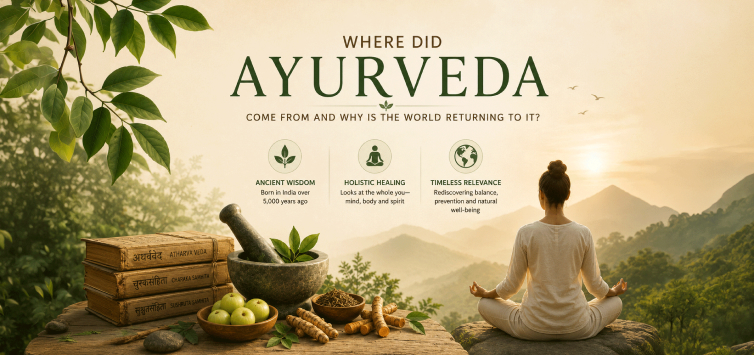
What if the secret to feeling genuinely well had existed for thousands of years, quietly waiting for the rest of the world to catch up?
People across the globe are moving away from quick fixes. They want healthcare that listens, that looks at the whole person, not just the symptom. Ayurveda has been doing exactly that for over 5,000 years.
It began in India, but its relevance today is deeply universal. This is a walkthrough of where it all started and why its history still holds meaning for your health.
What Ayurveda Really Means?
The word Ayurveda comes from Sanskrit. Ayur means life, Veda means knowledge. Together, it simply means the science of life. Fundamentally, Ayurveda is about balance. It looks at health through the lens of your lifestyle and what is happening inside your body. Instead of focusing on just the symptom, it looks at what may be causing it in the first place. Prevention matters here as much as healing. It is a system built on the idea that the body, when supported well, knows how to restore itself.
Where It All Began
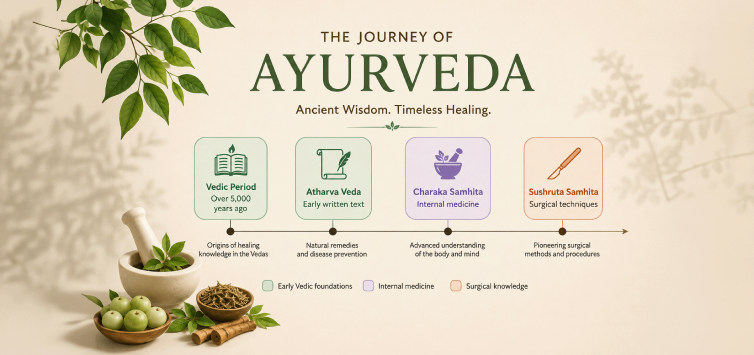
Ayurveda’s roots go back to ancient India, long before modern medicine had a name. Its earliest knowledge lived within the Vedas [a body of sacred texts that covered everything from philosophy to healing]. The Atharva Veda, in particular, documented early healing practices centred around natural remedies, longevity, and keeping illness at bay. This was not folklore. It was structured, observed, and passed down with intention. Over time, this knowledge took the shape of a complete medical system.
How Ayurveda Became a Complete Medical System?
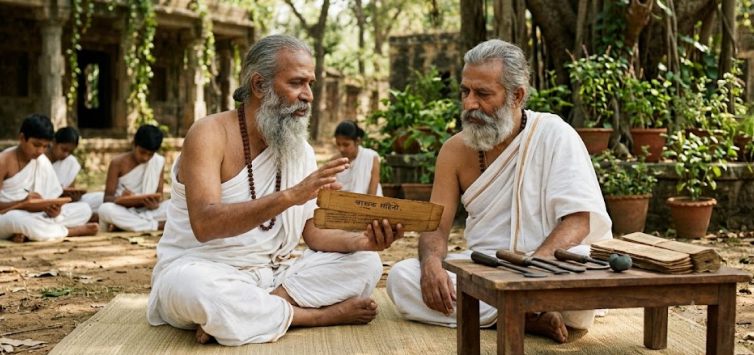
Ayurveda did not begin as a written system. For generations, this knowledge was shared directly from teacher to student before being compiled into texts still studied today.
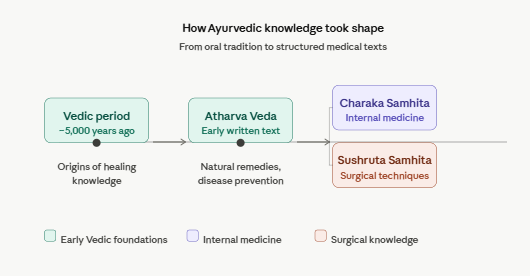
Two scholars played a defining role in this shift. Charaka focused on internal medicine. He studied how the body functions and how disease develops from within. His work laid the foundation for diagnostics and holistic treatment.
Sushruta, on the other hand, documented surgical methods in remarkable detail for his time. He described procedures and instruments that were far ahead of their era.
Together, their contributions turned Ayurveda into a structured and teachable medical science.
How Ayurveda Reached the World?
Ayurveda grew well beyond the borders of ancient India. Between roughly 800 BCE and 1000 CE, it became a system that other civilisations actively sought out.
Scholars and travellers from Persia, Arabia, and Central Asia studied Ayurvedic texts and carried those ideas home. This exchange worked both ways. Ayurveda also absorbed influences, refining itself through contact with other healing traditions.
| Region | Nature of Exchange |
| Persia | Adopted Ayurvedic plant-based remedies and diagnostics |
| Arabia | Integrated concepts into early Islamic medicine |
| Central Asia | Carried texts along trade and scholarly routes |
| Southeast Asia | Blended Ayurvedic principles into local healing systems |
This period marks the transition of Ayurveda from a regional medical tradition to a system with a genuine global reach.
Ayurveda’s Quiet Resilience and Return
Colonial rule brought Western medicine into dominance across India. Formal institutions shifted focus, and Ayurveda was gradually pushed to the margins of official healthcare.
Yet it held on. For a large part of the population, it remained the primary system of care throughout that period. The revival came steadily. Post-independence India invested in Ayurvedic institutions and formal education. Today, global interest has added significant momentum.
The Ideas That Have Stood for 5,000 Years
Some things about Ayurveda have simply never needed to change.
At its core, the philosophy rests on three ideas:
Health is balance
The body and environment are always in conversation with each other. When they are in harmony, the body functions well.
Disease is imbalance
Illness develops gradually. It is the result of disruption, whether through diet or environment, building up over time.
Treatment is personal
Two people with the same condition may need very different care. Ayurveda has always understood that the individual matters as much as the illness.
These principles feel remarkably current. They align closely with what modern integrative medicine is only beginning to formalise. That is perhaps the most telling sign of Ayurveda’s enduring value.
Why This History Matters to You Today
Understanding where Ayurveda comes from changes how you relate to it. It is a medical tradition that has been tested and refined across millennia.
The world is shifting. Lifestyle-related conditions are rising globally. More people are questioning why symptoms keep returning without lasting results. The conversation around personalised medicine is also growing in mainstream healthcare.
Ayurveda has been working within exactly this framework for thousands of years:
- Preventive care: Supporting the body before illness takes hold
- Root-cause focus: Addressing what created the imbalance, not just what it looks like
- Personalised treatment: Recognising that every individual has a unique constitution and responds differently
For someone coming from a system where healthcare often feels reactive, Ayurveda offers something genuinely different. A slower, more attentive approach to health.
Experiencing Ayurveda Where It Truly Began
There is a meaningful difference between reading about Ayurveda and experiencing it in the place where it originated.
India remains the most authentic setting for Ayurvedic care. The practitioners here carry knowledge passed through generations, supported by formal training and clinical experience.
What makes the experience distinct:
- Access to practitioners trained in classical Ayurvedic medicine
- Personalised programmes built around your constitution and health goals
- Treatments that follow traditional protocols within a comfortable, well-supported environment
Conclusion
Ayurveda is not a relic. It is a system that has evolved over centuries while staying grounded in its core principles. For those exploring natural or integrative healthcare, this history builds trust. It shows that the system has supported real people across cultures and generations.
Coming to India for Ayurveda is about accessing a living medical tradition in its most complete form. At Deepam Meditour, international patients can explore authentic Ayurvedic care with guidance tailored to their health goals and travel needs. Whether you are seeking preventive care or a more holistic approach to well-being, understanding Ayurveda’s origins is a good place to begin.
FAQs
Q1. How old is Ayurveda, and where did it originate?
Ayurveda originated in ancient India. It is one of the world’s oldest medical systems, dating back over 5,000 years. Its knowledge first appeared in Vedic texts. It later evolved into structured medical texts such as the Charaka Samhita and Sushruta Samhita.
Q2. What makes Ayurveda different from conventional medicine?
Conventional medicine focuses on specific symptoms or conditions. Ayurveda takes a broader view. It considers lifestyle, diet, environment, and mental state together. The aim is to identify the root cause and restore balance.
Q3. Can Ayurveda help with modern lifestyle conditions like stress, digestive issues, or fatigue?
Yes, these are common reasons people seek Ayurvedic care. Ayurveda addresses lifestyle-related imbalances through a structured approach. Treatment may include diet changes and guided therapies. Each plan is tailored to the individual.
Q4. Is it safe to try Ayurveda if I am already on medication?
Yes, but proper guidance is important. A qualified practitioner will review your health and current medications first. Ayurvedic treatments are generally gentle, but they should always be personalised.
Q5. Why should I travel to India for Ayurveda rather than trying it locally?
Ayurvedic practice can vary widely across regions. In India, you access classically trained practitioners and authentic therapies. Many centres offer structured, supervised programmes. This allows consistent and closely monitored care.
Q6. How long does an Ayurvedic treatment programme typically last?
The duration depends on your health goals. Wellness programmes may last 7 to 14 days. Therapeutic programmes often run for 3 to 4 weeks. A practitioner will recommend the right duration after assessment.
Ayurveda Centers
Related Blogs
-
 How to Choose an Authentic Ayurveda Treatment Centre... September 9, 2026
 -
 Where Did Ayurveda Come From and Why Is... August 16, 2026
 -
 A Natural Approach to Managing Constipation with Ayurveda August 6, 2026
 -
 Can Ayurveda Help With Sports Injury Recovery? August 5, 2026
 -
 A Complete Guide to Ayurveda Treatment in India... January 5, 2026
 -
 How Diabetes Slowly Affects Your Vision Before You... December 15, 2025
 -
 How Does Ayurveda Support Bone Health as We... November 20, 2025
 -
 Can Diet Play a Role in Cancer Prevention?... October 20, 2025